
What Behaviour Change Science Actually Tells Us About Becoming a New Parent
Mar 30, 2026
There is a particular kind of exhaustion that belongs exclusively to the first weeks of new parenthood. It is not the tiredness of a long day, or even a long week. It is the tiredness of someone who has been asked to become an entirely different person, overnight, without a map, while also keeping a small and wholly dependent human alive.
If you are in that place right now, or if you have been in it and still carry it with you, I want to start here: you are not failing. You are not behind, and the difficulty you are experiencing is not a reflection of your love for your child, your readiness for parenthood, or your capability as a person.
It is, in large part, simply the nature of one of the most profound developmental transitions a human being can undergo, and the science of behaviour change, when applied honestly to this period, tells us something that our culture has been remarkably slow to say out loud.
Why Standard Behaviour Change Advice Misses the Point
Much of what we know about behaviour change- forming habits, building routines, sustaining motivation, making incremental progress toward a goal- rests on a foundational assumption: that you are the same person at the end of the process as you were at the beginning, only with different behaviours.
The fourth trimester breaks that assumption entirely.
Becoming a parent for the first time is not a behaviour change. It is an identity transformation. The person who walked into the delivery suite and the person who walked out with a baby are not the same person in any psychologically meaningful sense. The neural pathways are literally different. The hormonal architecture is different. The social role, the sense of self, the relationship to one's own body, the priorities, the fears, the capacity for a particular kind of love that has no equivalent elsewhere in human experience- all of it is different.
Yet the advice that tends to reach new parents sounds remarkably like standard behaviour change coaching. Sleep when the baby sleeps. Build a routine. Take it one day at a time. All of it is well-intentioned, but much of it, for parents in the acute phase of the fourth trimester, is practically useless.
What is actually needed is something more honest, more grounded, and more compassionate. What is needed is a framework that acknowledges what is genuinely happening, rather than one that glosses over it with productivity language.
Matrescence: Finally, a word for what this is
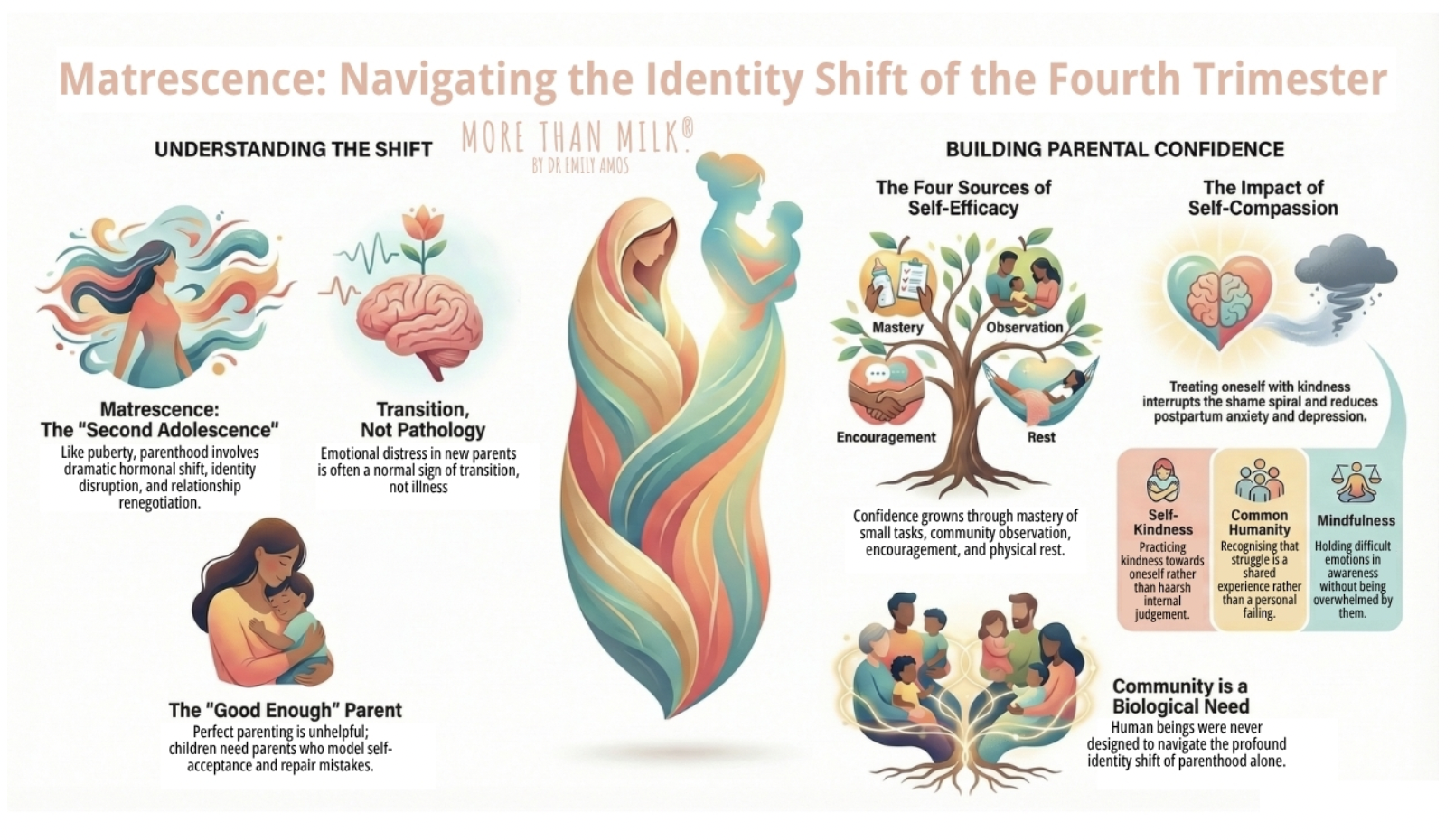
In 1973, American medical anthropologist Dana Raphael coined a term that should, by now, be as familiar as the word adolescence. She called it matrescence: the developmental transition to motherhood.
The term was revived and significantly expanded in 2017 by reproductive psychiatrist Dr Alexandra Sacks, who observed in her clinical practice that a significant number of new mothers were presenting with emotional distress that did not meet the clinical criteria for postpartum depression, and yet clearly indicated that something profound and disorienting was underway. They were not ill. They were in transition.
Sacks drew the comparison that Raphael had begun: matrescence, like adolescence, is a period in which the body changes, hormones shift dramatically, identity is disrupted and rebuilt, and relationships are renegotiated at every level. We understand, as a culture, that adolescence is difficult. We give teenagers years to navigate it. We do not expect them to feel grateful and joyful throughout. We extend considerable patience to the process of becoming.
We do not, as yet, extend the same understanding to matrescence. The cultural script for new motherhood is one of fulfilment, radiance, and gratitude. The reality, for the vast majority of new parents, is considerably more complex. It contains love of a ferocity that is almost frightening. It also contains grief for the self that existed before, exhaustion that defies description, ambivalence that is entirely normal and not at all a sign of inadequacy, and a profound sense of not yet knowing who you are in this new role.
Naming this transition matters both clinically and personally. When there is no word for an experience, people tend to pathologise it or internalise it as personal failure. When there is a word, there is a framework- and with a framework comes the possibility of meeting the experience with something other than shame.
Matrescence applies, in its psychological dimensions, to all new parents, not only mothers. The parallel concept of patrescence, describing the identity transition in new fathers and non-birthing parents, is less developed in the literature but no less real in the lived experience of the people I work with.
What Actually Builds Confidence in the Fourth Trimester
Once we accept that the fourth trimester is an identity transition rather than a behaviour change problem, the question becomes: what does the research actually tell us about how new parents develop confidence and capability in this new role?
The answer comes largely from the science of parental self-efficacy, a concept grounded in psychologist Albert Bandura's Social Cognitive Theory. Parental self-efficacy describes a parent's belief in their capacity to organise and carry out the tasks involved in caring for their child. Crucially, self-efficacy is not the same as competence. It is not whether you can do the task. It is whether you believe you can. That belief, the research consistently shows, is one of the strongest predictors of parenting outcomes.
Bandura identified four sources from which self-efficacy is built, and all four are worth understanding if you are in the fourth trimester, or supporting someone who is.
The first, and most powerful, is mastery experience: successfully completing a challenging task reinforces belief in the capacity to do it again. In the context of the fourth trimester, this means that every feed that goes well, every settling that works, every nappy changed in the small hours of the morning is not a small thing. It is evidence, deposited slowly into a developing sense of capability.
The second source is vicarious experience: watching others navigate the same task successfully. This is one of the clearest arguments for community in the fourth trimester. New parents who are isolated from other new parents miss out on one of the primary mechanisms through which confidence is built. Seeing another parent struggle with the same things, and manage, is not just reassuring. It is biologically instructive.
The third is verbal persuasion: the encouragement and genuine acknowledgement of others. Not empty reassurance, but specific, honest recognition of what a parent is doing well. The fourth trimester is a period in which new parents are exquisitely sensitive to criticism and often deeply undernourished in genuine validation.
The fourth source is physiological and emotional state: anxiety, exhaustion, and emotional overwhelm directly reduce self-efficacy. This is why sleep deprivation in the fourth trimester is not merely uncomfortable. It is clinically undermining. A parent who is chronically sleep-deprived is a parent whose capacity to build confidence in their role is being systematically eroded, through no fault of their own.
The Internal Environment: Why self-compassion is not optional
If parental self-efficacy is the mechanism through which confidence develops, self-compassion is the internal environment that makes that development possible.
The research of psychologist Kristin Neff has established self-compassion as a construct with a robust and growing evidence base. She defines it as comprising three interconnected elements: self-kindness in moments of difficulty, rather than harsh self-judgment; recognition of common humanity, the understanding that struggle and imperfection are part of the shared human experience rather than evidence of individual failure; and mindfulness, the capacity to hold difficult emotions in awareness without suppressing or over-identifying with them.
In the fourth trimester, all three elements are under sustained pressure.
New parents, particularly new mothers, are frequently subjected to an internal critic of extraordinary severity. The standards applied to oneself as a parent tend to far exceed anything applied to any other area of life, and unlike performance at work or progress toward a personal goal, the consequences of perceived failure in parenting feel existentially high. The result is a level of self-directed criticism that actively impedes the very learning process that builds capability.
The evidence is consistent: self-compassion is associated with lower rates of postpartum anxiety and depression, greater emotional resilience, and improved capacity to regulate emotional responses to the inevitable stresses of early parenthood. The mechanism appears to be that self-compassion interrupts the shame spiral that self-criticism produces. Where self-criticism says, "I am failing," self-compassion says, "this is hard, and I am trying, and that is enough for now."
The paediatrician and psychoanalyst Donald Winnicott gave us the concept of the "good enough" parent: a parent who is present, responsive, and loving in a consistent but imperfect way. Winnicott argued, and decades of attachment research have supported, that perfect parenting is not only unnecessary but actively unhelpful. Children need a parent who can repair ruptures, tolerate their own imperfection, and model the kind of self-acceptance that supports healthy development.
Self-compassion, in other words, is not a luxury or a self-indulgence for new parents. It is, in a very precise sense, part of the care package for both parent and child.
The Role of Community: It is not just a ‘nice-to-have’
Everything described above, matrescence as a developmental framework, the building of parental self-efficacy through mastery and vicarious experience, the cultivation of self-compassion in place of self-criticism, is made significantly easier in the presence of genuine community and almost impossibly difficult in its absence.
Human beings are not designed to become parents alone. The anthropological record is clear on this point. New parents in isolated nuclear families, without the informal village of extended family, trusted neighbours, and experienced peers that characterised most of human history, are managing a process that was never designed to be managed alone.
The fourth trimester asks something extraordinary of new parents. It asks them to undergo a profound identity transition, acquire an entirely new skill set, sustain the life of a wholly dependent being, navigate a relationship that has also been transformed by the arrival of this child, and do all of this on fragmented sleep and in a body that is recovering from the physical demands of pregnancy and birth.
None of this is a reasonable one-person job, and the evidence is clear: social support is one of the most consistent predictors of positive outcomes for new parents, including reduced rates of perinatal mood disorders, higher parental self-efficacy, and greater capacity for self-compassion.
If you are in the fourth trimester and you are struggling, the most important thing you can do is not find a better routine or a more efficient feeding schedule. It is to move toward other people who understand what this is, and allow yourself to be witnessed in it.
What This Means in Practice
The fourth trimester is not a problem to be solved. It is a transition to be supported.
It means understanding that the difficulty is not pathological. Matrescence is a developmental transition, not a disorder. The ambivalence, the disorientation, the grief for the former self, the love that is simultaneously overwhelming and terrifying- all of it is within the normal range of a profound and underacknowledged human experience.
It means building confidence through doing, not through knowing. Parental self-efficacy is not built by reading more, worrying more, or researching more. It is built by attempting the tasks of parenthood, tolerating imperfection, and allowing the accumulated evidence of managing to quietly do its work.
It means practising self-compassion as a genuine priority, not an afterthought. The internal voice with which a new parent speaks to themselves matters, both for their own wellbeing and for the emotional environment in which their child is developing.
Most importantly, it means seeking community with genuine intention, not because you should, but because the research is unambiguous: other people are the most powerful resource available to you in this period.
A Final Word
If there is one thing I want to leave you with, it is this.
The fourth trimester is hard because it is supposed to be hard. Not in a punishing way, but in the way that any genuine transformation is hard. You are not the same person you were. The person you are becoming does not yet fully know themselves. That in-between place, that liminal territory of not-quite-old-self and not-yet-settled-new-self, is uncomfortable in proportion to how significant the change is.
Becoming a parent is, by any measure, one of the most significant changes a human being can undergo.
Give yourself the grace of naming what this actually is. Find people who understand it. Build your confidence through the small, repeated acts of showing up for your child, even imperfectly, and speak to yourself, in those moments of doubt and exhaustion, with at least a fraction of the kindness you would offer to any other new parent standing in front of you.
That is not lowering the bar. That is meeting yourself with the honesty and warmth that this transition deserves.
Want to learn more about how my courses can help you to feel confident and empowered in the fourth trimester and beyond?
Stay connected with news and updates!
Join our mailing list to receive the latest news and updates from our team.
Don't worry, your information will not be shared.
We hate SPAM. We will never sell your information, for any reason.
